
Margeaux Poppins: Monster Hunter

🎨
NOTE: This post is a reference only; illustrative of the concept and is not an official publication of Sound & Color.
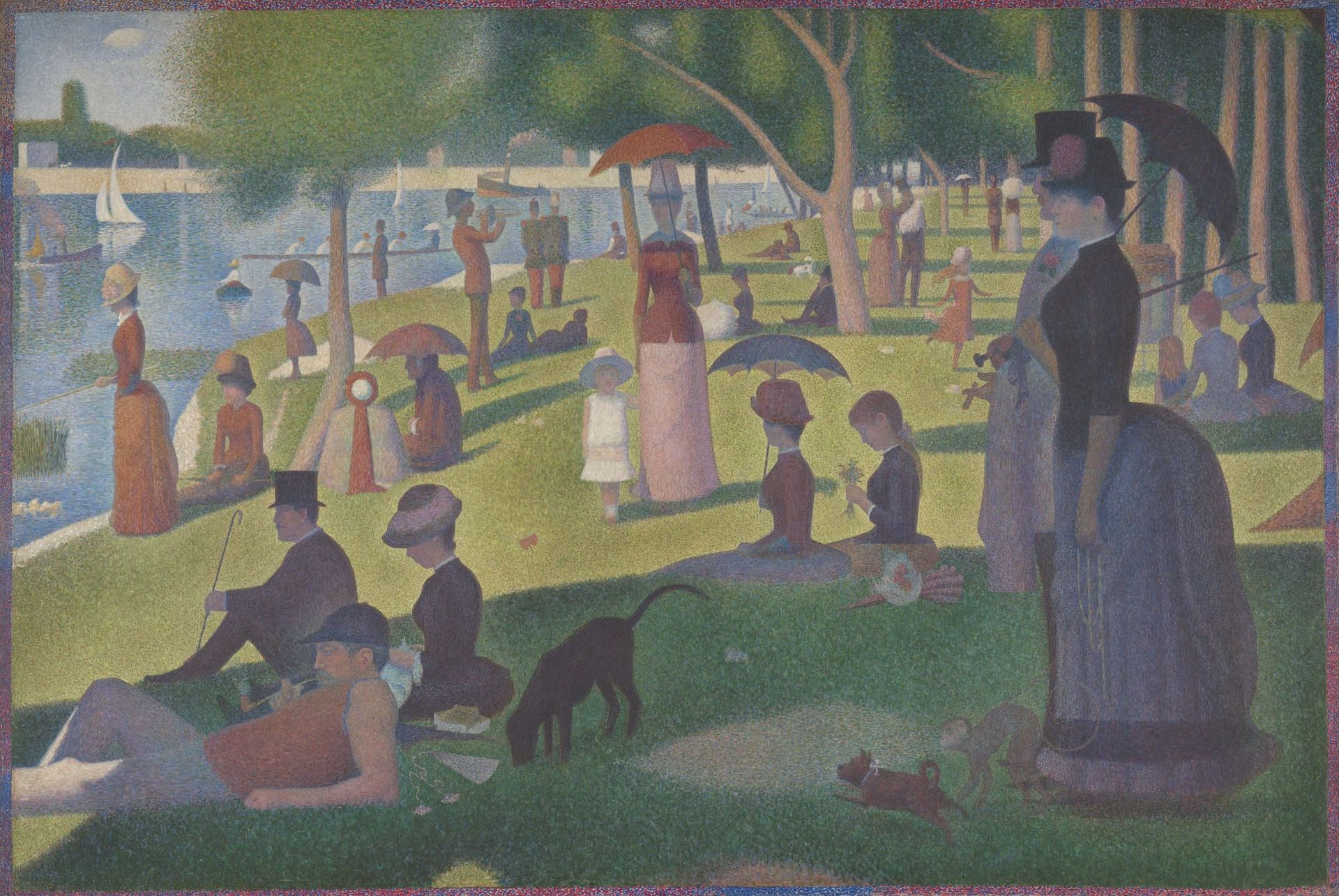
Author's Introduction: It might occur to you that I am a fractured Disney child in the body of one buxom adult. You’d be correct. I’ve wanted to do something for a while about that scene in Mary Poppins where she, the chimney sweep, and the two precocious scamps hop into a sidewalk chalk tableau for a romp with the bow-tied penguins. It’s all very saccharine and musical. But there’s a moment where we glimpse something unrequited between Bert and Mary. Something she acknowledges but can’t be bothered about, apparently. And that made me cranky. But also: I love a museum. Here, I’ve applied the world-jumping magic to Mary’s sister and Seurat’s A Sunday on La Grande Jatte. Margeaux possesses the same power but has bills to pay and is much more prone to romance.
Author's Introduction: It might occur to you that I am a fractured Disney child in the body of one buxom adult. You’d be correct. I’ve wanted to do something for a while about that scene in Mary Poppins where she, the chimney sweep, and the two precocious scamps hop into a sidewalk chalk tableau for a romp with the bow-tied penguins. It’s all very saccharine and musical. But there’s a moment where we glimpse something unrequited between Bert and Mary. Something she acknowledges but can’t be bothered about, apparently. And that made me cranky. But also: I love a museum. Here, I’ve applied the world-jumping magic to Mary’s sister and Seurat’s A Sunday on La Grande Jatte. Margeaux possesses the same power but has bills to pay and is much more prone to romance.
Seurat’s A Sunday on La Grande Jatte is arguably the Divisionist masterpiece. It is at once a scientific study, an optical illusion, and as an iconic tableau of the 1880s bourgeoisie at leisure along the Seine, it exists as a social commentary when set against its sister piece, Bathers at Asnières. Figures in too many clothes seek shade among tall park trees. Rowers row, sailors sail. There is a monkey. But now in the distance just beyond the trumpet player, a grinning, impish Payne’s-gray blob with a forked tail appears to be sinking a steamboat and performing with one clawed hand the gesture colloquially known as “flipping the bird.”
“Well, that’s unsavory, isn’t it?” Margeaux sits back from the examining table. The conservator, Dr. Charlotte Cadogan, isn’t amused by the waggle of Margeaux’s eyebrows. The lighting in the room is low, making more pronounced the tittering onlookers in the bright hallway beyond her.
Margeaux’s reputation has preceded her.
“It isn’t a mold I’ve ever seen,” Dr. Cadogan says sharply. Her voice is regal, serious. “Chromatography’s ruled out foul play. And . . . it moves. Yesterday it was a storm cloud over the Seine. Today it’s . . . that.”
“Yeah, they do that.” Margeaux snorts. She likes to keep it light.
Dr. Cadogan blinks. “They? Who is they?”
Margeaux searches her brain for the words, but there is never a way to answer this question and seem sane. Not before the first time an observer experiences the wonder or horror of Margeaux disappearing into a painting.
“Mr. Powell here recommended you but couldn’t explain to do what exactly.” Dr. Cadogan gestures with her head at a waifish, older, mostly bald man standing in uncomfortable awe on Margeaux’s other side.
Margeaux nods at him and he twitches a smile. She remembers him from her least favorite gig at the Louvre in which the creature inhabiting John Martin’s Pandemonium had been allowed to fester too long.
“So what do you do?” she insists impatiently.
“I can tell you here at the beginning that I am considered an exterminator. The rest, you unfortunately won’t understand until the end,” says Margeaux. She hopes it comes across as charming.
Dr. Cadogan, however, appears to vibrate. It’s not unlike the tremor before a volcanic eruption. She is made of a rigid posture, equal parts curves and angles, suggesting a weight lifting hobby. Her bottom lip is swollen from being anxiously chewed even as it moves to form some kind of response. Her wide-if-suspiciously-lidded deep brown eyes are encased behind horn-rimmed glasses and she wears a severe sort of bun but the hair is dyed a dusty-rose color. Margeaux posits that she is perhaps a dutiful Aunt Charlie, fun on weekends with a number of delicious hidden watercolor tattoos beneath that suffocating turtleneck. A veritable governess of Candy Land.
Margeaux, in her stained blue coveralls and Chuck Taylors, is only a bit more decorous than a chimney sweep. Her thick dark curls are claw-clipped unceremoniously to the back of her head, and the spray of moles across her broad nose are themselves a sort of paint splatter. Her sister, named for the saint, is posh by contrast and drags children on saccharine romps through sidewalk chalk art as a babysitting activity. Margeaux the Misadventurer, the Misguided (her family had meant “the Lesser,” but that didn’t so much work with the alliteration), has dedicated her talents to battling the violent horrors someone was releasing into ancient, priceless worlds of art. It is another mystery that often leaves her scarred but occasionally provides her the opportunity to play knight to a lovely conservator’s damsel in distress.
And Dr. Cadogan is distressed. There’ll be a hole chewed in her lip at any moment.
She shoots Mr. Powell an irritated look.
“Mr. Powell, the door,” she huffs finally. But his head tilts at the painting, focused as he is on studying the creature, yearning to spot the instant it moves again. “Mr. Powell. Door.”
He startles and shuffles past them both, shushing and shooing the workers who have gathered in the hallway to see the art witch jump into a painting.
Dr. Cadogan closes her eyes, pressing the bridge of her glasses against her nose. “I don’t have time for this. We are the first museum to get this piece on loan s—”
“Since 1958. Fire at the Whitney,” Margeaux says with a smooth smile. “I’m impressed; you must be very persuasive.”
Charlotte falters. The compliment is unexpected. “Right. If word gets out my facilities have some kind of . . . morphing mystery infestation, I’m fucked.” The curse comes out as a quiet hiss before escalating. “Fucked. We’re all fucked.” Her slender hands clench and release, revealing nude-lacquered nails and a number of delicate gold rings. Margeaux notes with some delight that there’s no ring at all on the marriage finger.
Margeaux returns Dr. Cadogan’s magnifying lens, careful to allow their fingers to brush but hoping Charlotte doesn’t notice the bit of ochre pigment beneath Margeaux’s nails. She could only appear but so dirty and still potentially desirable.
“I promise you’re in good hands,” she says cheerily, collecting from a stool her worn rucksack jingling with supplies. “Ask anyone. I haven’t destroyed a painting yet.”
Mr. Powell makes a small, objecting noise behind Dr. Cadogan, and Margeaux tosses him a threatening squint before urgently stepping backward and issuing them both a salute.
“Back in a wink.”
Margeaux goes to place a hand on the painting when her hand goes through it instead, followed by the rest of her. Dr. Cadogan leans as if to tackle her before she can touch it, and the alarmed, protective gasp tunnels into “what the fu—” as the real world fades around Margeaux’s toes.

Embedding oneself inside pointillist art—in a word—sucks. Nothing is ever what it is from the outside. Figures and shapes take form only through will and forced perspective. Losing focus means even the air around Margeaux turns to packing peanuts.
Nineteenth-century pointillist Paris is a sea of technicolor sprinkles. The summer breeze carries on it the scent of 150-year-old paint and dry archival air redolent of the hallowed halls where the painting had been hung. Monet’s Water Lilies had at least smelled of water lilies. But that was the Impressionists, for you.
Only the tracks of the beast registered as anything solid. Blobs of dark blue gray interrupted mottled cobblestone and the field of green specks that made up garden lawns.
It very much sounds like a summer day. The Seine gurgles and swishes like a waterway. Horns and bells on sailing vessels blast and tinkle their presence. Conversations carry on around her in a simulated French. The dots that loosely form pedestrians on the bridge turn to observe her scalpel-tipped polearm and rumpled costume from the future and even grunt French-ly about it, but none approach her.
Margeaux is halfway across the bridge when she hears frantic splashing and mouthless screams. As she peers over the wall, the boys from Asnières flee the western riverbank without their clothes as a hulking creature holds the head of one of their compatriots under the gently lapping waves.
She backpedals, hopping over a low iron fence, and chucks a loose cobblestone that cracks the creature hard in the back of its head. It roars its displeasure and turns to face her, giving the boy time to reconstitute himself and take off up the hill.
The beast is formidable met on its own scale. A razorback wolverine the size of an elephant. Its face has a humanoid quality to it, enough that Margeaux can discern the sneer around its tusks and a taunt in the glare of its eyes. It knows her. The beasts are legion, all part of the same pest, but she has yet to meet its master.
She smiles, impressed with herself in some moments. Her sister wouldn’t know what to do with a proper villain.
“Where is your master, little one?” Margeaux calls, staking her staff in the soft ground.
“Where is your master, little one?” the beast responds mockingly in a booming voice.
“You’re a sassy one,” Margeaux replies with a shrug. She plucks up the staff and makes a show of fixing her grip around it. “Bet you’ll go down the same, though. Come on. Let’s see.”
The beast lowers its head with a deep growl, raising its hackles and digging its claws into the earth. And then turns tail and takes off down the riverbank, scattering the dots known as people like so many gnats.
“Goddammit.” Margeaux sighs and goes after it.
The inner worlds of paintings are finite places. They lose most of their form just past the frame, and most of their context not far beyond that. The beast can’t get far before it isn’t a beast at all, but it must be killed, dismembered, and dissolved before it reaches the blank canvas white of the nothing beyond. Otherwise, it can return.
Margeaux is relieved not to have to chase it through all of Paris, but things have historically not gone well when she is dragged to some secondary location.
Her claim to never have destroyed a painting before has an asterisk. As with any profession, there was once a time when she was bad at this and the result was a little blood loss and a lot of debt borne in secret. As a result, she is very, very single.
Witches are not a highly dateable archetype to begin with, so this piece she doesn’t take entirely on herself. But it’s difficult to describe what she does for a living; she works in art but is not an artist. Injuries can be even harder. Her apartment is . . . fine. Furnishings are unintentionally minimalist and breakfast is often last night’s pizza, but she finds herself to be good company and to have excellent taste in streaming media. Sure, there’s probably romance in being able to whisk a lover away into some ancient artwork, but it felt cheap and skeevy to offer on a first date.
Her sister, Mary—aloof, temporal, terrible with names—would die alone eventually as an unknowable hallucination to pockets of strangers. Margeaux craved more permanence, to be known through and through as a fixture in one person’s world. Or two people. Four, if they had kids.
Dr. Cadogan is not only gorgeous but could reasonably be expected to withstand Margeaux’s interminable art history ramblings. Maybe she even loves pizza.
But first things first: the hero bit. Margeaux metaphorically saves Dr. Cadogan’s life.
The beast crashes through the edges of buildings, unable to corner properly in an urban environment. The structures dissolve on contact, creating clouds of paint specks for Margeaux to swat her way through before re-forming behind them. She’s lost her bearings but rounds a corner and comes skidding to a halt at the edge of the Arc de Triomphe’s plaza. The beast stands before the arch, gasping great, heaving breaths. The structure itself before them, an ominous gateway into nothing. Its edges fizz and fray as if being gradually consumed by the white void behind it.
“Are we done?” Margeaux calls, panting as she holds her knees. “Is this . . . your stage?”
The beast’s roar shakes free a layer of the world around them. The dots that compose the light accents of the plaza drift upward into the void and disappear.
“That’s new,” she mutters to herself.
The beast charges. Margeaux’s first lunge is unsuccessful. The creature knocks away her blade and swipes her left shoulder with a broad clawed paw, sending her after the weapon. The pain is always real, even if the world is malleable. She screams as she hits the ground but cannot stay there long, as the beast dives at her with its teeth. She dodges, sending it jaw first into the ground, and drops a foot on top of its head hard enough that it bites off its own tongue.
While it’s distracted by its own pain, Margeaux collects her staff and puts some distance between herself and the beast to recover her own lost breath. Her shoulder is in pieces; Payne’s gray filled each slash mark and mingled with her blood to turn a muddy color. The entire front of her is a skid mark of red-orange brick dust and plaza dirt. The blade of her staff still gleams, however. And she can move, which is enough.
Across the plaza, the creature is raring for another charge, dark blood oozing in thick rivulets from where its tongue had been. It tries to say something, but Margeaux shakes her head.
“I’m sure you’re being very clever. We’re nearly done here, though, so come on.”
The creature’s shoulders tremble and its fur stands on end as it blasts toward her. They trade in flurry of blows and swipes, Margeaux slinging stripes of the creature's blood across the plaza with every successful swish of her blade. She is kicked and winded but has been kicked and winded a hundred times before. She slices clean through a foot, severing it at the ankle, and knows the fight is over as the creature tries to limp away.
She follows as it drags its body back beneath the arch, an attempt to get as close to oblivion and rebirth as possible before she spears it in its back. The roar is weaker this time, more mournful. It turns itself onto its back to look at her when she pulls the blade again. Its features are nearly indiscernible this close, but its teeth are still white and she knows the curl of a smile when she sees one.
It utters the vowel sounds of something as its mouth leaks blood onto the stonework. “See you again” or similar, Margeaux presumes. It would be familiar.
“I know,” Margeaux replies, and brings the blade down across its neck.
Exhausted, she crosses back to the 16th arrondissement, where she dropped her bag, and returns slowly to the body to get to work.
The dismemberment isn’t like hacking through bone. The flesh of the beast is thick and gelatinized, paint mixed with whatever magic ichor makes it live. It takes mostly just time to divide it into melon-sized pieces capable of fitting into a dozen mason jars of a turpentine-based dissolving solution she’s developed over the years. When they’ve broken down, each jar is filled with blue and flecks of who-knows. She piles the jars back into her bag and inspects herself as best she can. Pointillist mirrors are useless. She is always grateful to her former self for having the foresight to pack a bottle of water. Half goes down her throat, the other half over her head to start rinsing off the day’s adventure.
The white void continues its hum beyond the Arc. People begin forming again on the edges of the plaza, seemingly unaware of it. The world resumes its movement and Margeaux heaves her bag over her good shoulder with a grunt and leans more on her staff as she returns to the Seine and the painting’s door.

Margeaux waits fitfully as Mr. Powell summons Dr. Cadogan over the phone.
The flakes of paint embedding in the gashes on her shoulder are themselves a risk for some sort of ghastly infection she’ll have to sort out later. More ghastly, though, is the state of her hair. She musses and unmusses it in the antique mirror, desperate to develop some kind of appeal before Dr. Cadogan sweeps in. If she is going to swoon, it is going to be from their unbearable chemistry, goddammit, not blood loss.
“Christ!” Dr. Cadogan bolts into the room, her glare alarmed and accusing, but she stops short of coming near Margeaux. Instead she hugs the wall, circling the examining table and eyeing both it and her intensely.
“Mission accomplished,” Margeaux declares. Mr. Powell hands Dr. Cadogan a magnifying lens to inspect the scene again and she snatches it from him, pointing a lacquered finger at Margeaux.
“You disappeared,” she states.
Margeaux nods. It’s often best to let people work these things out for themselves.
“Into the painting.”
Margeaux nods more.
“And you’re all . . .” Dr. Cadogan gestures at the state of Margeaux’s entire body.
“Well, it’s not a tidy business, but”—Margeaux holds up one of the glass jars of shimmering blue liquid—“there’s your problem.”
Dr. Cadogan squints at the jar before turning to examine for a long time the painting, where no trace of the beast or any other disturbance remains. Margeaux waits patiently for her to be satisfied, sharing darting glances with Mr. Powell.
A hunch appears in Dr. Cadogan’s back, the first falter in her statuesque posture to suggest she is stumped. She turns over Margeaux’s jar beneath a desk lamp. They all know she doesn’t know what she’s looking for.
“So . . . how?” she finally asks, a gentle curiosity emerging in her voice for the first time.
Margeaux gathers her nerve. Confidence, girl, confidence.
“There’s a long answer to that,” she replies. “About a dinner’s length if you’re up for it.”
Dr. Cadogan’s eyebrow flickers upward. She inspects Margeaux, sweaty, disheveled, bruised knuckles, paint-splattered. Wily. Bright-eyed. A keeper of her word.
She walks away with a swish and flourish of raspberry-scented air, past the painting, though she continues to inspect it. A lamp clicks on at a desk on the far side of the room, and she scribbles quietly. When she returns to Margeaux, there is a pause and she flips a business card over in her hands, seemingly uncertain what to do with it.
“Good work.” Dr. Cadogan clears her throat. “Mr. Powell can show you to accounts payable on your way out. He’ll . . . also get you my schedule. I look forward to hearing more about . . . whatever this was.” She extends the card abruptly, her fingers grazing Margeaux’s lightly before she waves at the scrapes on Margeaux’s shoulder. “And get that looked at. It looks dangerous.”
She nods her orders at Mr. Powell and then breezes past the both of them. There is whispering in the hallway when the door opens, and then the sound of scattering before the decisive clicking of Dr. Cadogan’s stilettos on the marble floor.
Margeaux exhales dramatically and sinks against a stool as Mr. Powell looks on. He seems impressed, relieved for her, and he smiles as she collects herself.
“Whenever you’re ready,” he says in a soft voice. Margeaux inevitably gets to her feet, biting her lip to keep from grinning too widely as they head out into the bright hallway. She inspects the card in the light of tall windows, streaming in early-evening sunlight, and notes a phone number in shimmering purple ink on the back of it beneath a name: Charlie.
Author Bio
L. D. Lewis (she/her) is a publisher, editor, Locus and Hugo Award-winning project manager, and Shirley Jackson award-nominated writer of speculative fiction. She is a co-founder of FIYAH Literary Magazine, creator of the Ignyte Awards, and former researcher for the LeVar Burton Reads podcast. As an author, her published works include Year of the Mer (Saga Press/Titan Books), novellas The Dead Withheld (Neon Hemlock) and A Ruin of Shadows (Dancing Star Press), and her short fiction includes appearances in a number of online publications, Neon Hemlock anthologies, and Jordan Peele’s Out There Screaming. Kai Ashanti Wilson once called her "unusually kind and full of good sense", which was pretty neat. She currently pays the bills as the development director at Clarion West, and lives in Georgia on perpetual deadline with her partner, two cats, and impressive fountain pen and LEGO build collections.
Reprinted - Originally published at Sunday Morning Transport, Nov 3, 2024
Newsletter Sign-Up
Get Our Emails


Member discussion